Research
One in Five Gave Up a Car: What the Research Actually Says About Cargo Bikes
Published 10 August 2026 · 6 min read
“A cargo bike can replace a car” is the kind of claim that gets repeated until nobody checks it. So it is worth reading the study that actually measured it: Michael Bissel and Sophia Becker surveyed 2,590 cargo bike sharing users across Germany and published the results in Transportation Research Part F. Their finding is more interesting than the slogan — and more honest about where cars still win.
What the study measured
The researchers looked at 58 cargo bike sharing schemes in Germany and asked users two things: had access to a cargo bike changed their car ownership, and how did they rate cargo bikes against cars on the motives that actually drive travel decisions — cost, flexibility, speed, comfort, safety, status, enjoyment, environmental impact.
Nearly 20% of respondents reported that using a shared cargo bike led them to sell a car or abandon a planned purchase. Crucially, this was not confined to households shedding a second or third vehicle. Many were one-car households, which means the cargo bike was absorbing the ordinary trips people assume require a car, not just the surplus ones.
Why people made the switch
Environmental concern was the strongest motive, cited by around 80% of participants. Close behind came money — the running costs of owning a car in a European city are relentless in a way that a bike's simply are not. Respondents also pointed to health and daily activity, a lack of interest in driving, feeling more comfortable on a bike than behind a wheel, and the plain practicality of a vehicle sized for short urban trips.
Reading the list, what stands out is that almost none of these are cycling arguments. They are household arguments. The cargo bike won because it fitted the life, not because its owners wanted to be cyclists.
Where cars still win — and the study says so plainly
This is the part usually left out of the headline. Participants rated cars superior on several instrumental attributes: long-distance travel, travel speed, comfort, weather independence and perceived traffic safety. The authors do not paper over it. Their conclusion is that cargo bikes reduce car dependency rather than eliminate car ownership outright.
In practice that means most families do not go from two cars to zero. They go from two to one, or from driving daily to driving on weekends. The car stops being the default for the school run and the supermarket, and becomes the thing you take to the Vosges on a Sunday.
The finding that matters most
Buried in the abstract is the most revealing result: users who had reduced car ownership rated cargo bikes more favourably than car-dependent users did. The relationship runs both ways. People who commit to the bike discover it works better than they expected, and that experience reinforces the decision.
This is why a trial matters more than a spec sheet. The study is, in effect, a large-scale record of what happens when people are given sustained access to a cargo bike rather than a ten-minute test ride. Perception changes with use — which is an argument for borrowing one for a fortnight before deciding anything.
What improves the odds
The authors identify three conditions that make cargo bikes more competitive with cars: better infrastructure, better cargo bike technology, and social norms that treat riding one as ordinary rather than eccentric.
Strasbourg is unusually well placed on the first. With over 600 km of cycle routes, a largely flat centre and a restricted-traffic historic core, the city removes most of the friction the study identifies. The third condition is arguably already met here — a cargo bike at a Strasbourg school gate attracts no attention at all.
The technology point, and where the minica fits
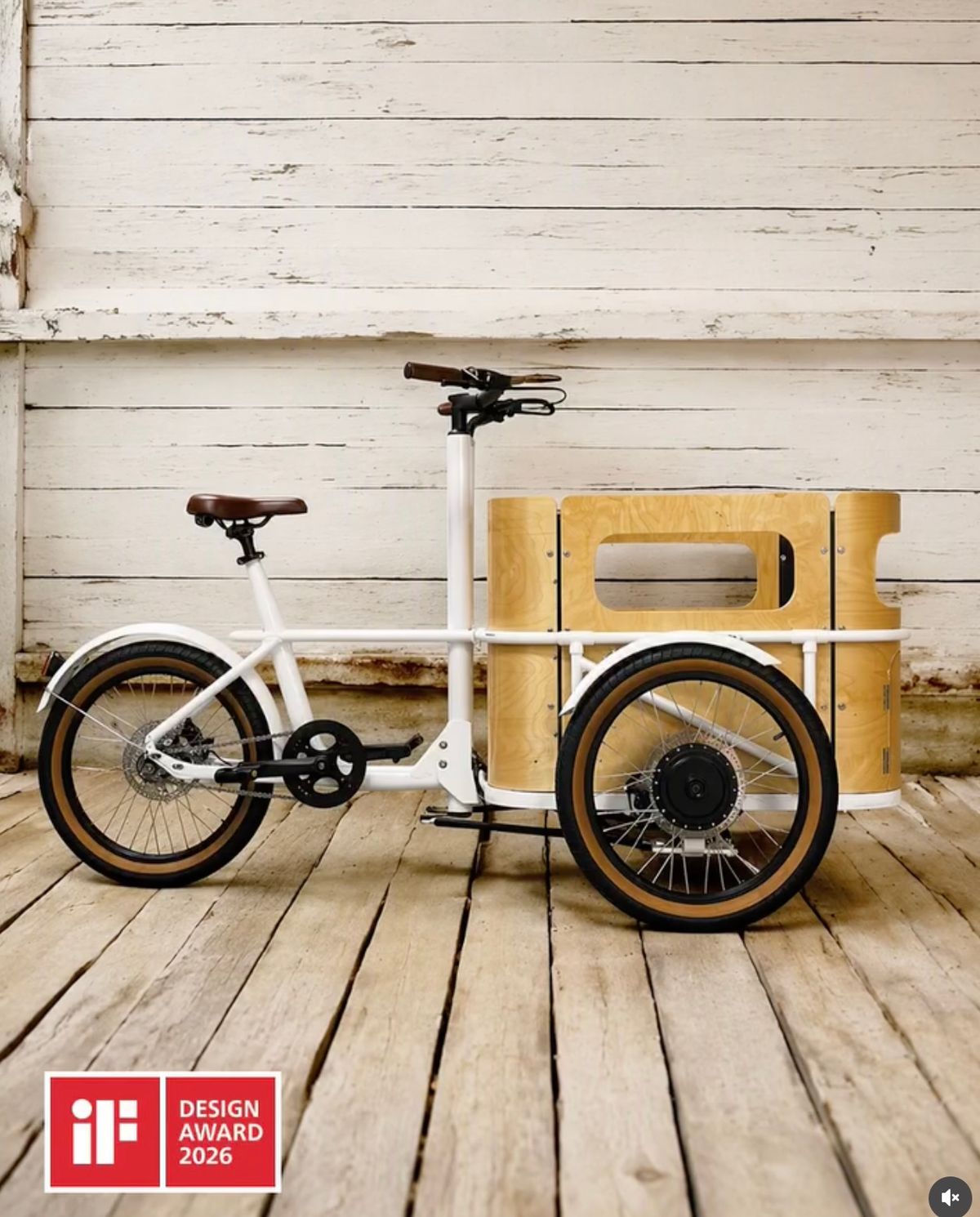
The second condition — technology — is where the last few years have moved fastest, and it maps closely onto how the minica was designed. Electric assist is what makes the safety and speed gap narrower: 80–100 N·m of combined torque means a loaded box does not turn every bridge into a decision, and an 800 Wh battery means range anxiety does not creep back in with two children and a week's shopping aboard.
The three-wheel format addresses the comfort and confidence objections directly — the bike stands up on its own while you load it, which is the moment most parents actually find difficult. The two-speed automatic hub removes gear changes at junctions. Its 300 kg total rated weight and an approved 223 kg carrying load including the rider is what turns "we could try it" into "we no longer need the second car", because the trips that break a cargo bike's usefulness are the heavy ones.
None of that makes the weather argument go away. The study is right about that, and so is anyone who has ridden across the Pont du Corbeau in February. But it does move the line on how many trips genuinely require a car — which, on the evidence, is fewer than most households assume.
The honest conclusion
The research does not say cargo bikes replace cars. It says that when people get real access to one, about a fifth of them decide they need one car fewer — and that the ones who do rate the experience highest. That is a considerably stronger claim than the slogan, because it is measured.
The reasonable next step is not a purchase. It is a trial long enough to find out which of your car trips were habit and which were necessity.
Ride this with
The options from this article, with what each one includes.
- minica cargo bike
Own one: the front-tub cargo e-bike, on display in Strasbourg.
See this option - 4 Hrs Cool Cargo cruise€59
Cargo e-bike for two — cruise the city together.
See this option - Good to know — what visitors highlight
Best e-bike rental prices in Strasbourg, staff who adjust every bike and share route tips, and WhatsApp for returns and follow-up.
See this option - Family Cargo Bike Comparison 2026: Where the minica Actually Sits6 min read
Price, torque, battery, payload and family capacity — the numbers that decide which cargo bike suits your household.
Read the guide
How to book
Three steps, no account needed. Free cancellation up to 24 hours before pickup.
- 1
Pick your ride
Choose a rental length — or the Cool Cargo bike for two — on the rentals page.
- 2
Reserve online
Pick your date and time in the booking widget. Reserve now, pay later on most options.
- 3
Collect in the centre
Pick up at 4 Rue du Faubourg-de-Saverne, 5 minutes from the station. Helmet, lock and map included.